
Excessive compensation, regulators with questionable side jobs, and the potential for massive returns for its financiers. Ever since Frisse Wind filed a class-action lawsuit against Tata Steel, it has been grappling with the rules governing charities and class-action lawsuits.
Are residents living near Tata Steel entitled to compensation? That question has been hanging over the market for some time now. The Frisse Wind.nu Foundation, founded by concerned parents, has been working for a few years on a class-action lawsuit against the steel giant. The former blast furnaces are among the largest factories in the Netherlands and, on their own, account for 0.5 to 1% of our total economy. It’s David versus Goliath, as Frisse Wind often puts it. And it helps that David has ANBI status: David is a nonprofit taking on a polluter.
But David hasn’t just had his sling and his stone for a long time now. David has called in reinforcements. And since then, things have gotten a bit murkier. An investigation by Hollands Welvaren reveals that Frisse Wind has strayed from the ANBI guidelines in several respects. Frisse Wind fails to disclose that one of its supervisors has ties to one of its financiers. And if Frisse Wind prevails in its claim, its financiers could potentially earn a return of as much as 2,000% on their investment.
What should be a landmark lawsuit concerning the health impacts of a large factory in a residential area is thus in danger of becoming a story about the influence of big money on our judicial process. And it raises the question of whether pursuing a worthy cause is really compatible with filing a massive lawsuit. In the worst-case scenario, this could cause the lawsuit to fail on procedural grounds, and the judge may never get around to ruling on the merits of the case.
The Big Money (including from Harvard)
Let’s start with the return on investment. Waging a major lawsuit costs a lot of money—money that Frisse Wind didn’t have. That’s why it turned to so-called litigation funders. These are companies that cover the legal costs in exchange for a share of the damages—if any are awarded. If they lose the lawsuit, the litigation funder loses all its money.
Frisse Wind partnered with two entities: Omni Bridgeway (Fund 5) Cayman Invt. Limited and the Dutch firm Redbreast. If they win, they will receive either a multiple of their investment or a percentage of the proceeds—whichever is higher.
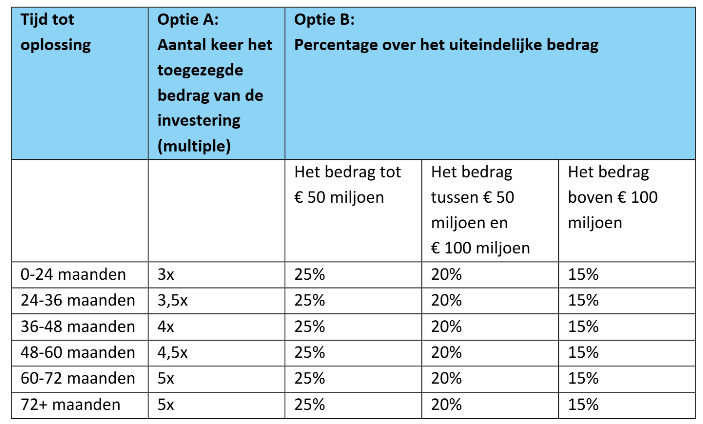
Using this formula, we can calculate how much the litigation funders will receive if Frisse Wind is indeed successful in its claim for “at least” 1.4 billion euros. That would amount to 217.5 million euros for them.
So if Frisse Wind wins, it’ll be a windfall for the Cayman Islands. (Fun fact: some of that money will end up at Harvard University, which is an investor in the Omni Bridgeway fund.)
As *De Groene Amsterdammer* noted—which, coincidentally, also published a major story this week on litigation financing: “It’s clearly stated on the Frisse Wind website.”
However, there is one crucial figure missing that would help put this amount into perspective. Yes, 200 million euros is a lot of money. But is it too much money? To answer that question, we need to know how much money Omni Bridgeway and Redbreast have invested in the case—something Frisse Wind refuses to disclose to Hollands Welvaren. But it is possible to make a well-founded estimate.
Frisse Wind reached an agreement with the litigation funders in 2024 or 2025. In the 2024/2025 fiscal year, Omni Bridgeway committed 517 million Australian dollars to 52 lawsuits. That works out to an average of 6 million euros per case—but that is, of course, an average, and the amount for Frisse Wind could be higher. Redbreast says it aims for investments ranging from 1 to 6 million euros, but three extracts requested by Hollands Welvaren from the Chamber of Commerce showed that the typical investment is around 1 million euros. In addition, over the past two years, Frisse Wind has received 1.2 million euros each time (though there is no guarantee that the amount will be the same every year).
Taking all these factors into account, 10 million euros—up to a maximum of 20 million euros—seems like a reasonable estimate of the investment made by the litigation funders (Frisse Wind declined to comment on this calculation). With that figure, we can calculate the return they would receive if Frisse Wind were to succeed in its 1.4 billion claim. With a 10 million euro investment, the return would be well over 2,000% (20 times the investment). With 20 million euros, it would be “only” 1,000%.
This article is for paid members only
To continue reading this article, upgrade your account to get full access.
Subscribe NowAlready have an account? Sign In