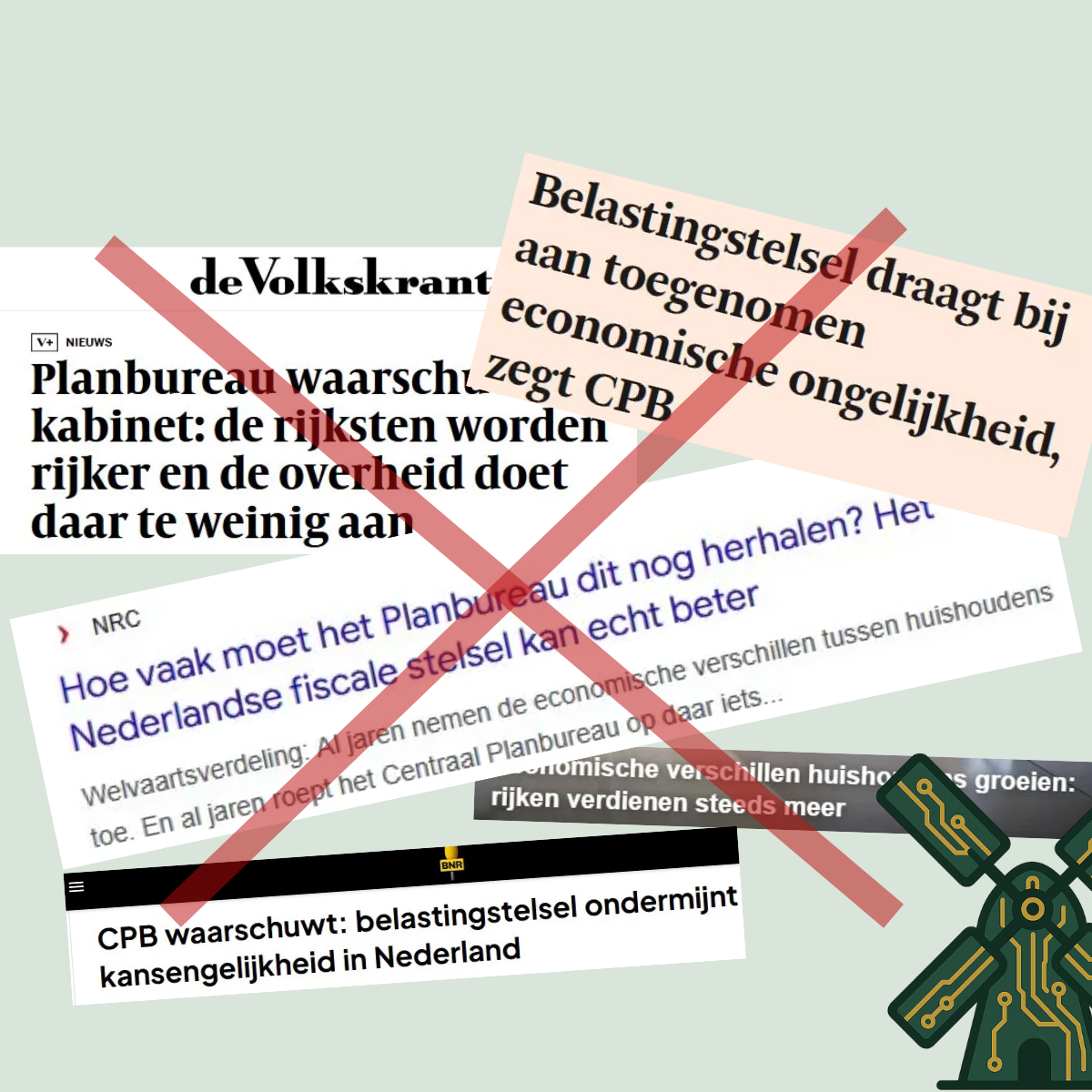
Tax capital more and labor less, so that work pays off again. You hear this cliché everywhere. But the tax burden on labor has already fallen significantly in recent years. It’s just been done so half-heartedly that almost no one has noticed. It’s not the tax system, but politicians and columnists who are stoking the fear of having to work more.
Let’s get a little worked up for a moment. There’s a tax scheme that costs 38 billion euros and is“ineffective or inefficient.” It’s the kind of scheme that sensible economists, policymakers, and columnists invariably say would be better off abolished.
But there are millions of people who benefit from this. And so there are parties like the VVD that are fighting tooth and nail to maintain the status quo: hands off! A nice little example of what Volt’s sole member, Laurens Dassen, referred to this week in *Trouw* as“constituency subsidies.”
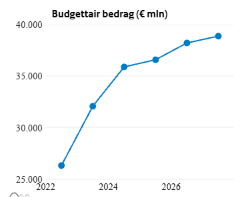
But… This isn’t about the mortgage interest deduction. That only costs a lousy 12 billion euros. This is about the earned income tax credit, which is more than three times as large. A tax credit that has grown so large in recent years that it nets every working person an average of more than 400 euros per month. That’s much more than the mortgage interest deduction. For most people, that deduction isn’t even half that amount.
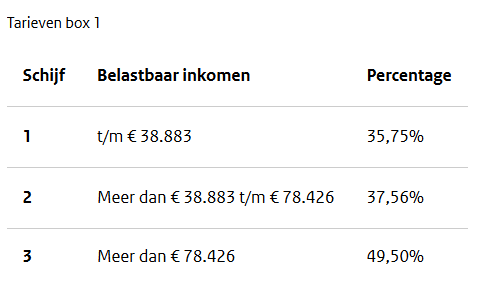
The earned income tax credit has become so large that it makes a mockery of the official tax rates on labor, which range from 35.75% to 49.50%. The problem is that those rates are very visible. And they’re often compared to the various tax rates on capital gains. “Entrepreneurs pay ‘only’ 19 to 25.8% in income tax,” you hear people say. And on your capital gains in Box, you pay 36%, which is much less than the top tax rate for wage earners.
But in practice, if you're employed, you pay much less in taxes. This is mainly due to the earned income tax credit, but also to the General Tax Credit (a tax credit of 27.3 billion euros).
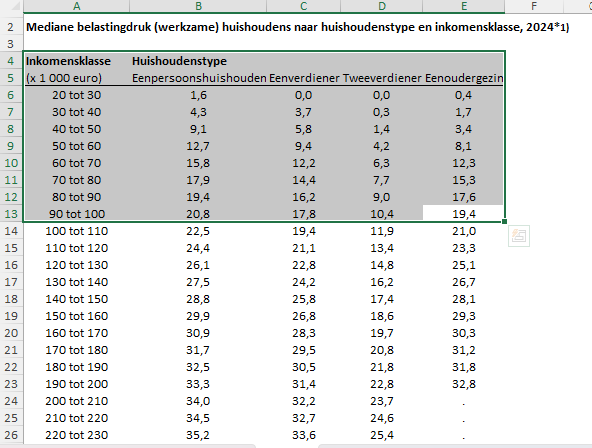
A dataset from Statistics Netherlands shows that most households with a combined income of less than 100,000 euros (roughly equivalent to two average-income earners) have a tax burden of less than 20 percent. This means they simply keep 80 percent or more of their “hard-earned” euros for themselves. And this is in a country where the government takes 46.2% of all money to redistribute and spend.
Not only is the tax burden on workers low, but it has also declined in recent years—especially for people with low and middle incomes. Half of all workers now pay less than 12.3% of their income in taxes, according to a recent report by Statistics Netherlands (CBS). Ten years ago, that figure was 15.4%.
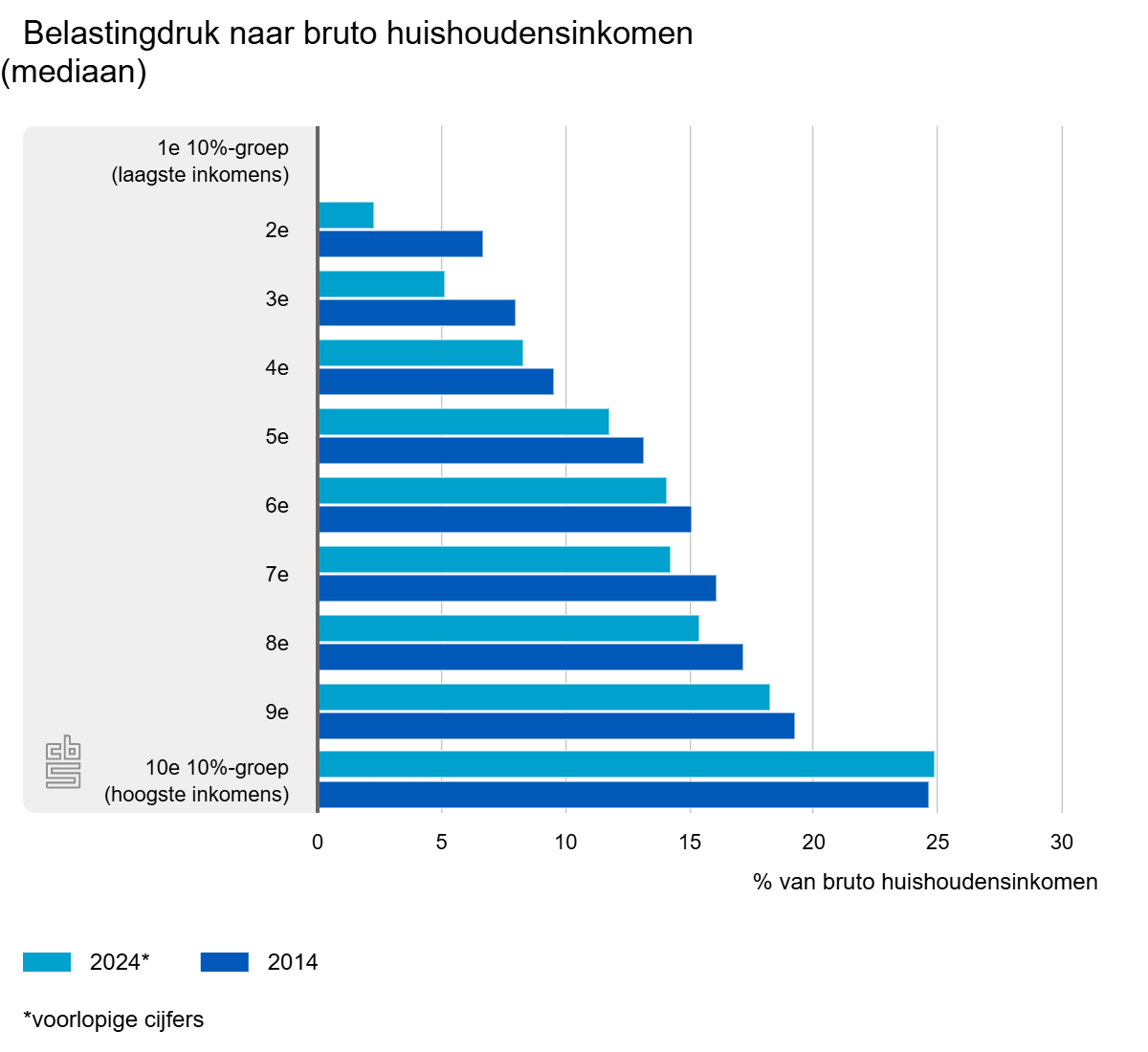
You can say a lot about the VVD. But as a party that has been involved in governing the country all these years, it has certainly made sure that work pays better.
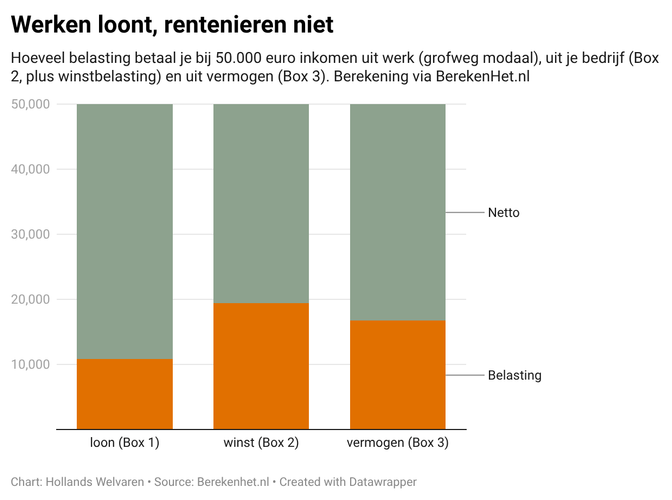
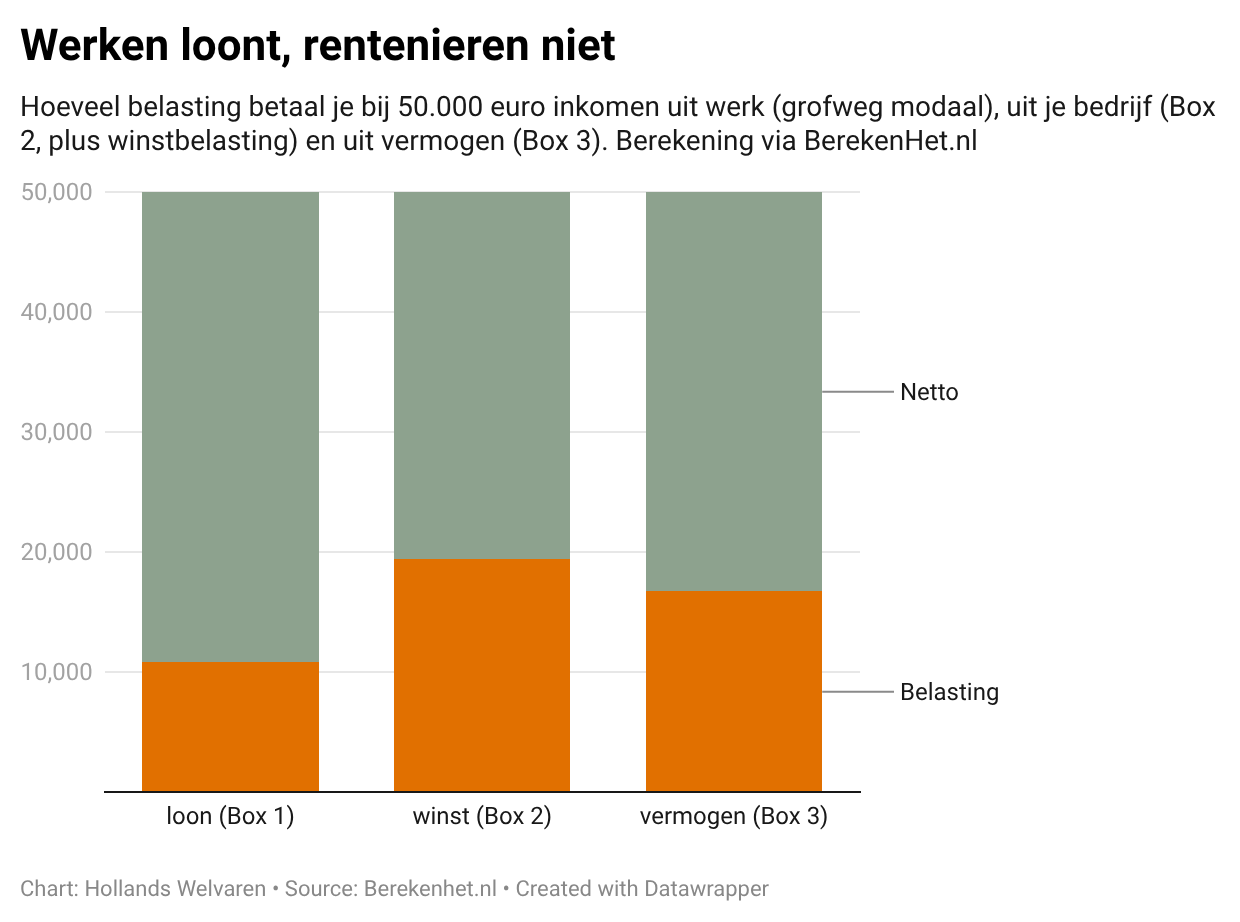
You often hear that labor is taxed more heavily than capital in the Netherlands. This is especially true for middle-class assets such as one’s home and pension. However, in the Netherlands, capital gains are often taxed more heavily. Someone who earns 50,000 euros per year—roughly the median income—pays less tax on that amount in Box 1 than they would if they earned the same amount from assets (Box 3). An entrepreneur with their own private limited company who makes that amount in profit and pays it out to themselves pays even more.
The shift in the tax burden is so significant that it is clearly reflected in the statistics. In 2023, 46% of all income tax revenue came from labor; ten years earlier, that figure was 56%, the government reported to the Senate last year. Tax revenue from capital, on the other hand, nearly doubled during that period, rising to 25%.

But why don't we see that? Why do people keep saying that work needs to pay off again and that wealth should be taxed more heavily? It's actually very simple. Because politicians and columnists are all saying in unison THAT WORK NEEDS TO PAY OFF AGAIN!!
And politicians and columnists know what they’re talking about, right? So it must be true. Outgoing State Secretary Eugène Heinen (BBB) submitted a study to the House last year that showed people actually have no idea how much extra tax they would pay if they worked more. People with lower incomes, in particular, overestimate how much extra tax they would have to pay if they worked more.
Of course, that’s partly because the tax system has become so complicated. If you earn more, not only do you pay the tax rate, but you may also lose certain benefits, your child’s supplemental student grant may be reduced, and your earned income tax credit and general tax credit may decrease. But the earned income tax credit can also increase... It’s hard to see the forest for the trees.
But all these uncertainties do not change this fact: for most people, working more can indeed be worthwhile. If you currently work part-time for fewer than 20 hours and start working one additional half-day, in most cases you’ll pay no more than 25% tax on that extra income, as researchers calculated a few years ago in the economics journal ESB. This calculation also took into account that some people would then need to arrange additional childcare, with all the associated costs. Only 2% of workers face an “extremely high marginal tax rate” of more than 80% on their additional income, the researchers state. These are primarily single people and single-income families.
So it’s not the tax system that discourages people from working more. It’s the people who argue that work should pay better who are perpetuating the culture of part-time work.
Is higher taxation the problem, or the solution?
Of course, not all workers are in a tax haven. If you’re in the middle class and have been working for more than half a week, you might end up paying roughly half of your salary for an extra day’s work to the tax authorities. But that’s also because, up until that point, you were likely paying very little in taxes—and therefore contributing very little to public services.
That might discourage people from working extra hours, but in practice, money is often not the main reason for working more or less. Various studies, including one by De Nederlandsche Bank, show that taking care of young children, yourself, your parents, or your hobbies is more important.
Answer to the question: Why don't you work full-time?
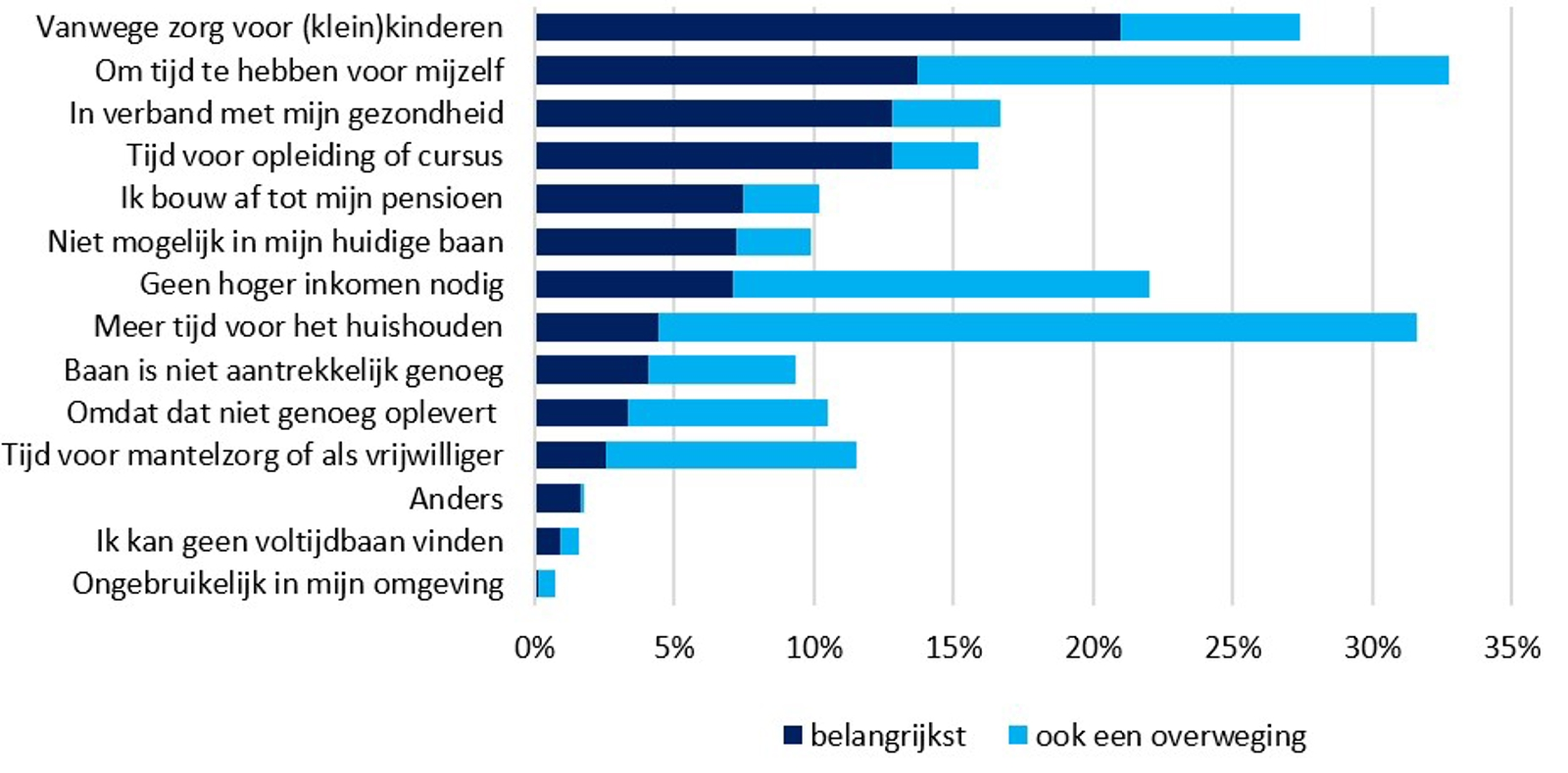
In other words: the better the public infrastructure—reliable child care, quality elder care—the greater the likelihood that people will work more. Perhaps it is precisely that extra tax—which pays for all those public services—that encourages people to work more.
Perception of the Problem
Actually, we could have known for years that the problem wasn’t the tax rate itself, but rather how it was perceived. In 2024, the Ministry of Finance commissioned an evaluation of the tax credits. Even then, researchers were critical of the earned income tax credit, which was consuming an ever-increasing number of billions. Theoretically, it rewards work more: the greater the tax credit, the greater the benefit. But in practice, that’s not how it works, because people don’t see the earned income tax credit. The amount of tax changes, but people’s perception does not change accordingly.
The researchers suggest that it would be better to simplify the tax system. Instead of combining high tax rates with complicated tax credits, such as the earned income tax credit, there should be a first tax bracket of 0% that depends on your situation. For working parents with young children, roughly the first 30,000 euros would be tax-free.
But a measure like that costs money. After all, a large-scale overhaul of the tax system always creates winners and losers. And the latter group must be compensated, which could cost many billions.
Such a simplification would, of course, be a good thing. But as long as politicians don’t dare to cut spending and implement reforms, it seems unlikely that there will be money for such a major tax overhaul. However, there is an easy way to get people working more again—a way that costs the treasury zero euros. Stop saying that work needs to pay off again.
Did you find this interesting? Then check out:
 Joris Heijn
 Joris Heijn
 Joris Heijn