
The government wants to radically overhaul the Box 3 tax system to appease right-wing parties. The Tax and Customs Administration is likely completely unable to handle this. And it throws the door wide open to tax avoidance. The solution? A simple and lower tax.
No, this story isn't about small savers who may or may not foot the bill for a new Box 3 plan.
No, this story isn't about yet another unfunded budget shortfall.
This story is about a government that promises “breakthroughs” but is actually threatening to dismantle the Tax Authority just to appease a few opposition parties.
This story is about right-wing parties that are so preoccupied with taxing "real returns" that they overlook a tax increase of 2.4 billion euros.
This story is about an ever-increasing tax burden that suddenly turns into a huge opportunity to defer your taxes until the cows come home.
And how things can be different.
An almost impossible task
It’s probably not a good idea to start a story about a dry topic like Box 3 by comparing it to another dry topic—like nitrogen. But maybe it helps. In both cases, politicians let a problem fester for so long (deteriorating nature, savers paying more in taxes than they received in interest) that the courts stepped in to put the brakes on it. And not just a little, but with full force.
Government officials were then faced with the nearly impossible task of solving the problem. Angry citizens are demanding a painless solution. But judges limit the options for cutting corners—something politicians would love to do.
And then, after many years of hard work, there was suddenly a breakthrough this week. In 15 months, there could be an entirely new way of taxing assets: a capital gains tax that applies to nearly all assets (90%) that are currently taxed under Box 3.
It *is* possible (to break it)
With this type of capital gains tax, you no longer pay a small amount of tax on your stocks every year; instead, you don't pay tax until you sell them at a profit.
Right-wing parties have been calling for years to tax “the real return.” That seems fair—especially since savers received little or no interest for years, yet the tax authorities applied a notional return of 4% on which a 30% tax was due. As a result, above the tax-exempt threshold, you effectively paid 1.2% of your assets to the tax authorities every year.

In the late 2010s, policymakers finally began to ease the burden on savers, but this had to be done in a budget-neutral way. So people with real estate and stocks ended up paying more. Instead of 1.2%, you now pay 2.16% annually on those assets (36% tax on a 6% return). This also includes the appreciation in value of rental property, even if it hasn’t been sold yet. In addition to savers, private landlords also feel disadvantaged by the current system.
A fertile ground for calls to tax "real returns."
But as Marnix van Rij (CDA), then State Secretary of Finance, emphasized back in 2023: that’s just very difficult. Van Rij in the House:
"The Tax Authority has made it very clear: under no circumstances could we conduct audits if everything were subject to capital gains tax. That makes sense, of course. After all, all those small investors with their stocks certainly don’t keep track of what their cost basis was or when they realized their capital gains."
The capital gains tax would be an amendment to the Actual Return on Investment Act (Box 3). That law has already raised several red flags in the so-called implementation review. The new system will be so complex that it will require about 900 additional staff members. Finding those additional staff members is a “nearly impossible task,” as the Council of State puts it.
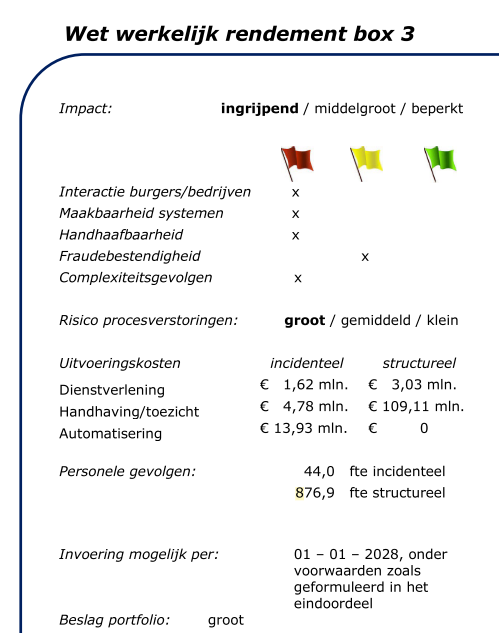
And now State Secretary Eerenberg is saying, after all: I’m going to make that shoddy law even more complex in order to secure support from right-wing parties for the Tax Plan. He’ll have to keep up a breakneck pace, though, because otherwise he’ll face a 2.4 billion euro budget shortfall, as can be inferred from one of the appendices on Box 3 that was sent to the House in June.

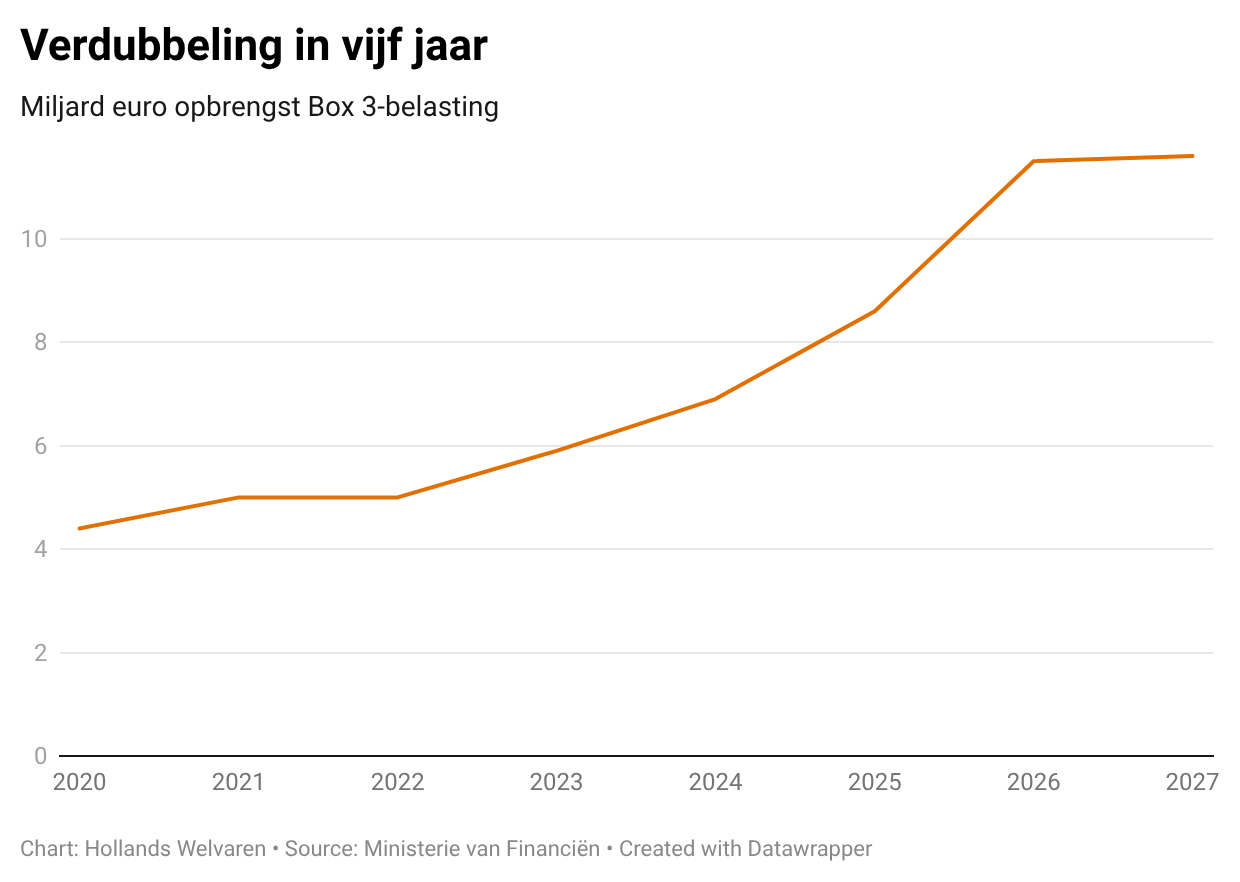
In other words: the Real Return Act essentially means that wealthy individuals will face a tax increase of more than 2 billion euros. And this is despite the fact that taxes in Box 3 have already risen significantly in recent years. Tax revenue has more than doubled in five years. This year, it is expected to total 11.5 billion euros.
You often hear right-wing parties talk about the importance of taxing “actual returns,” but you never hear them say that this actually means they want people to pay more taxes, rather than less. Or, well… Will people even be paying taxes under this new system?
Bye-bye, blue envelope
This article is for paid members only
To continue reading this article, upgrade your account to get full access.
Subscribe NowAlready have an account? Sign In