After years of neglect, politicians are finally paying attention to the crumbling business climate. So will everything be all right now? That will be tricky. Because these same politicians have in recent years become addicted to appeasing their voters - with money from that same business community.
Nowhere is the dilemma facing politicians more evident than in the VVD, where party leader Dilan Yesilgöz and Finance Minister Eelco Heinen are pulling in opposite directions. According to parliamentary group chair Yesilgöz, it’s “code red” for the middle class. In the“Agenda for Working Netherlands” presented earlier this year, she aims to provide the middle class with 1 billion euros in tax relief and higher benefits.
Of course, this isn’t a new stance for the VVD. Her predecessor as party leader, Klaas Dijkhoff, stated as early as 2019 that “the middle class is increasingly being squeezed.” He combined that with a slight aversion to multinationals. In 2018, those large companies did not come to the aid of Prime Minister and VVD leader Mark Rutte in the public debate over the abolition of the dividend tax. That caused a breach of trust between big business and its most loyal political ally, the VVD.
In a way, that actually worked out well for the VVD. Because money was needed to appease the middle class. When Klaas Dijkhoff left the Binnenhof—he is now“working on behavioral influence” and is a podcaster —his successor, Sophie Hermans, took the lead in 2021 to overhaul the national budget in a single evening after Prinsjesdag in order to accommodate all sorts of political pet projects. The business community was presented with a bill of 1.7 billion euros.
Traditionally, corporate taxation was a battle between the left and the right. The left was in favor, the right was against it. But when the VVD’s “dam” broke, it triggered a flood of corporate tax hikes.
All in all, successive (center-)right cabinets that included the VVD raised corporate taxes by 13.5 billion euros between 2018 and 2025, according to an analysis of figures from the Netherlands Bureau for Economic Policy Analysis (the Bureau does not have figures for before 2018). During that same period, households, on the other hand, received nearly 8 billion euros in tax cuts.
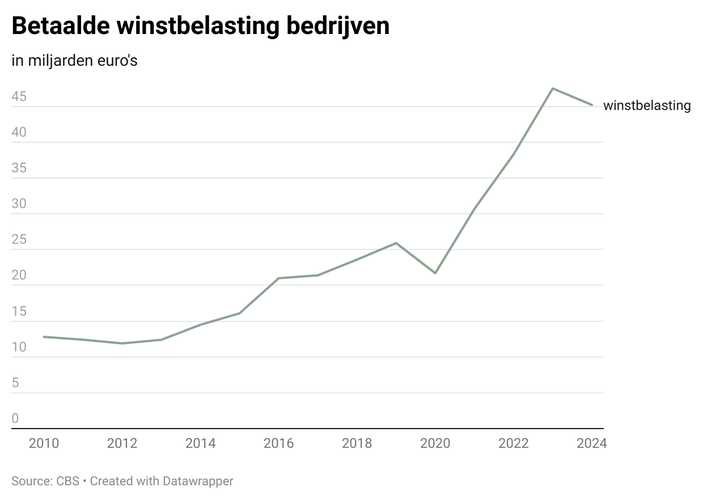
The graph above shows only the so-called “policy-driven” tax changes—the levers that politicians have actively adjusted. Of course, the government also collects more tax revenue when people earn higher wages or companies make more profit. But even when you factor that in, you can see that corporate income tax has risen much more rapidly. Between 2019—the last “normal” year before the pandemic—and 2024, companies paid 19.3 billion euros more in corporate income tax, an increase of 74 percent. Income tax rose at a relatively much slower rate, by “only” 35 percent.
Catering to the public—whether you call them families, voters, or the middle class—always comes at the expense of the business community. According to calculations by Hollands Welvaren based on CPB figures, 10 cents of every euro the government spends now comes from corporate income tax. The average over the past 25 years is 8 cents. At the same time, the contribution of payroll taxes to the welfare state actually fell by 2 cents, to 31 cents.
"You can't keep taxing companies indefinitely."
VVD leader Yesilgöz’s approach, then, is to have the middle class contribute even less to sustaining the welfare state—after all, they should receive even more tax cuts. But she has a problem. Last year, she put forward her party colleague Eelco Heinen as Minister of Finance. And he is on a completely different course. “We cannot continue to ‘tax companies indefinitely,’” he said recently in the House of Representatives. “The business climate is under pressure, and I think we underestimate how fragile our prosperity is.” As far as he’s concerned, the money spigot that has been used to appease citizens in recent years is about to be turned off.
Suppose you wanted to improve the business climate by reducing companies’ contribution to government spending to that long-term average of 8 percent; in that case, you’d have to channel about 10 billion euros into the business sector. That’s ten times more than Yesilgöz wants to allocate to resolve the “code red” situation for the middle class. So that’s serious money.
Of course, you could lower taxes for both voters and businesses. But then you’d have to either let the budget deficit grow or cut spending. And there are virtually no plans for the latter in the House of Representatives. During the election campaign, the parties mainly wanted to increase spending.
While it’s true that the VVD was the only party with serious austerity plans, virtually all of them have already been implemented in this coalition agreement—such as cuts to development aid and the elimination of the National Growth Fund. So the party has no new plans. You can now see in the United States what happens when austerity measures are implemented without a plan that has been thought through in advance and presented to the voters.
It’s great that politicians are taking the business climate seriously again. But that won’t amount to much unless they also take two other steps: telling voters that the days of being coddled are over, and starting to consider major, ambitious spending cuts and reforms. The Balkenende II and Rutte II governments did that too, so in theory, it should be possible.
But which politician would dare to tell such a new story?