The government’s new Box 3 plans could end up costing much more than previously estimated. The government is assuming that people will sell their stocks every 4.5 years and pay the new tax at that time. But no one can say what that assumption is based on. Millionaires have absolutely no reason to sell stocks on a regular basis. Billions in tax revenue could simply vanish.
Take your pick: Do you want to tax the rich much more, or not at all? Those seem to be the only two options left on the political agenda.
After successfully blocking much-needed reforms, the Siamese twins FNV and Progressief Nederland have now set their sights on taxing the wealthy. More than 22,000 people have already signed their petition, “Tax the Quote 500,” which was launched this week.
Imposing an additional tax on the super-rich is a disastrous plan. But on the right side of the political spectrum, an equally disastrous plan is brewing: the introduction of a capital gains tax. If you have assets, you only pay tax on them when you actually realize a gain—for example, when you sell a rental property or dispose of your stocks. If you don’t sell anything and don’t receive any income from dividends or interest, for example, then you pay nothing.
While the left is fighting a rearguard action, the right appears to be marching toward victory. On Prinsjesdag, D66 State Secretary Eelco Eerenberg made a concession to the right: he wants to introduce a capital gains tax on stock holdings as early as 2028 at a breakneck pace.
This gives millionaires, those with assets worth hundreds of thousands, and other stockholders a “tap” they can use to control the tax drain on their wealth. This is an effect that Eerenberg and his officials do not seem to have taken into account.
You might be thinking: but isn’t there a middle ground? No. The CDA has always leaned to the right on this issue. D66, which has always been a sort of “PRO-light” in this area, has now also changed its stance.
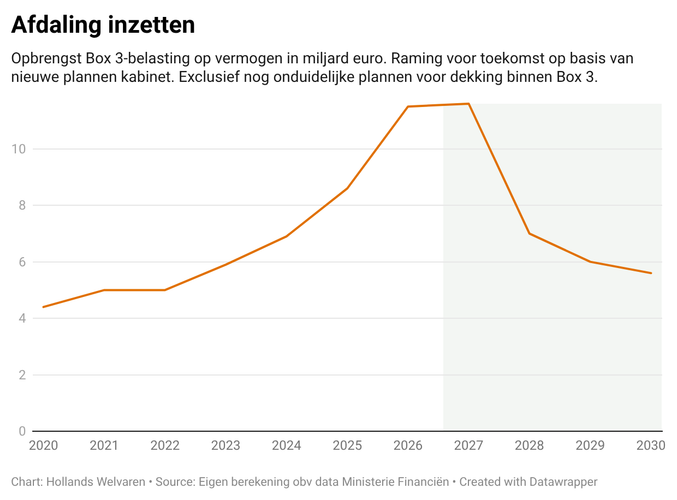
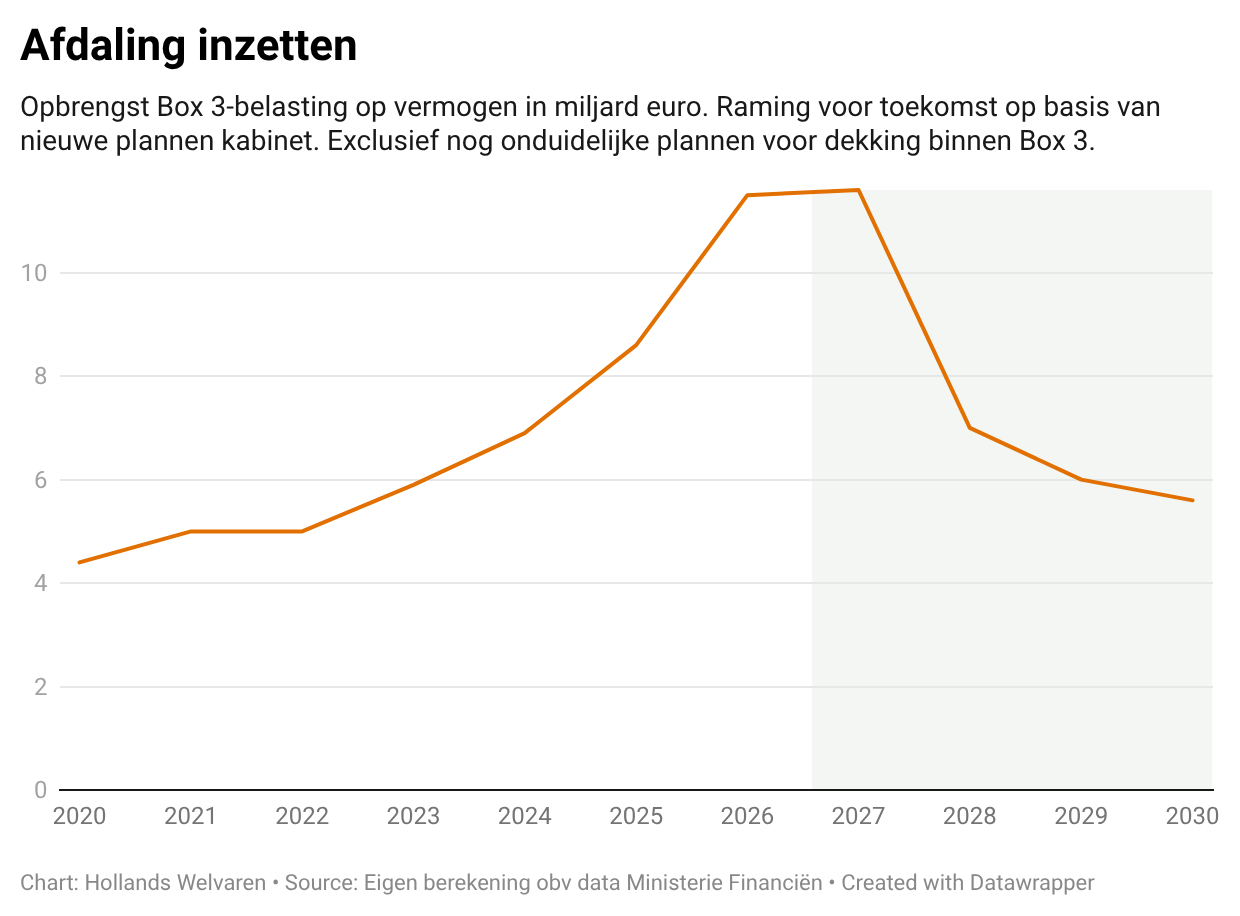
But is it really that bad? The media often reports that this tax may be collected a little later—only upon sale rather than every year—but that the money will still come in. As a result, there will be a total budget shortfall of 18 billion euros through 2040, but that money will eventually find its way into the treasury. And although there isn’t quite enough coverage for that enormous amount yet—small savers apparently have a lot of friends in Parliament—that problem seems solvable.
However, that enormous figure of 18 billion still seems to be an underestimate.
4.5—the magic number behind Box 3
The rationale behind that amount is that a stock portfolio is “sold approximately every 4.5 years.” Suppose that, when the new Box 3 system takes effect in 2028, you have 100,000 euros in stocks on which you make a profit of 10,000 euros each year. Under the old Box 3 plans, you would pay 36% tax on that profit each year: 3,600 euros. But in Eerenberg’s new plans, the Ministry of Finance assumes that you won’t sell them until 2033, at which point you’ll pay 18,000 euros in tax on the 50,000-euro profit all at once—tax that you would otherwise have paid in five smaller installments.
It’s no wonder that Box 3 income drops significantly at first. One person might sell everything as early as 2028, while another might not sell until 2033. But at some point within that period, most people will indeed pay Box 3 tax on their stock gains, according to the Ministry of Finance. Because of that 4.5-year assumption, there’s actually a sort of buffer built into the multi-year budget. You don’t know exactly when the money will come in, but you do know it will be sometime within those five years.
But the question is: Is that assumption realistic? Does such a barrier even exist? Hollands Welvaren searched for statistics or the reasoning behind that assumption, but couldn't find an answer anywhere.
The Ministry of Finance is not responding to questions about the assumption behind that 4.5-year period. “We are currently working on the explanatory notes before they are submitted to the CPB, and we cannot comment on them at this time,” a spokesperson said.
The Netherlands Bureau for Economic Policy Analysis (CPB) has therefore not yet verified this estimate of the costs associated with Box 3. Normally, these analysts “certify” the estimates to determine whether the Ministry of Finance’s projections are “reasonable and neutral.” However, because the decision-making process has not yet been finalized, the CPB has not yet begun this process, according to a spokesperson. It is unclear whether this calculation will be available before the House of Representatives votes.
Banks, which manage a large portion of retail investors’ shares, also do not have figures on the turnover rate of investments, they told Hollands Welvaren. The Dutch Central Bank (De Nederlandsche Bank), the regulatory authority, does not have any figures on this either.
In other words: there are no figures, and the Ministry of Finance’s rationale remains a black box for now.
However, the figures that are available do not bode well for the tax authorities.
This article is for paid members only
To continue reading this article, upgrade your account to get full access.
Subscribe NowAlready have an account? Sign In